


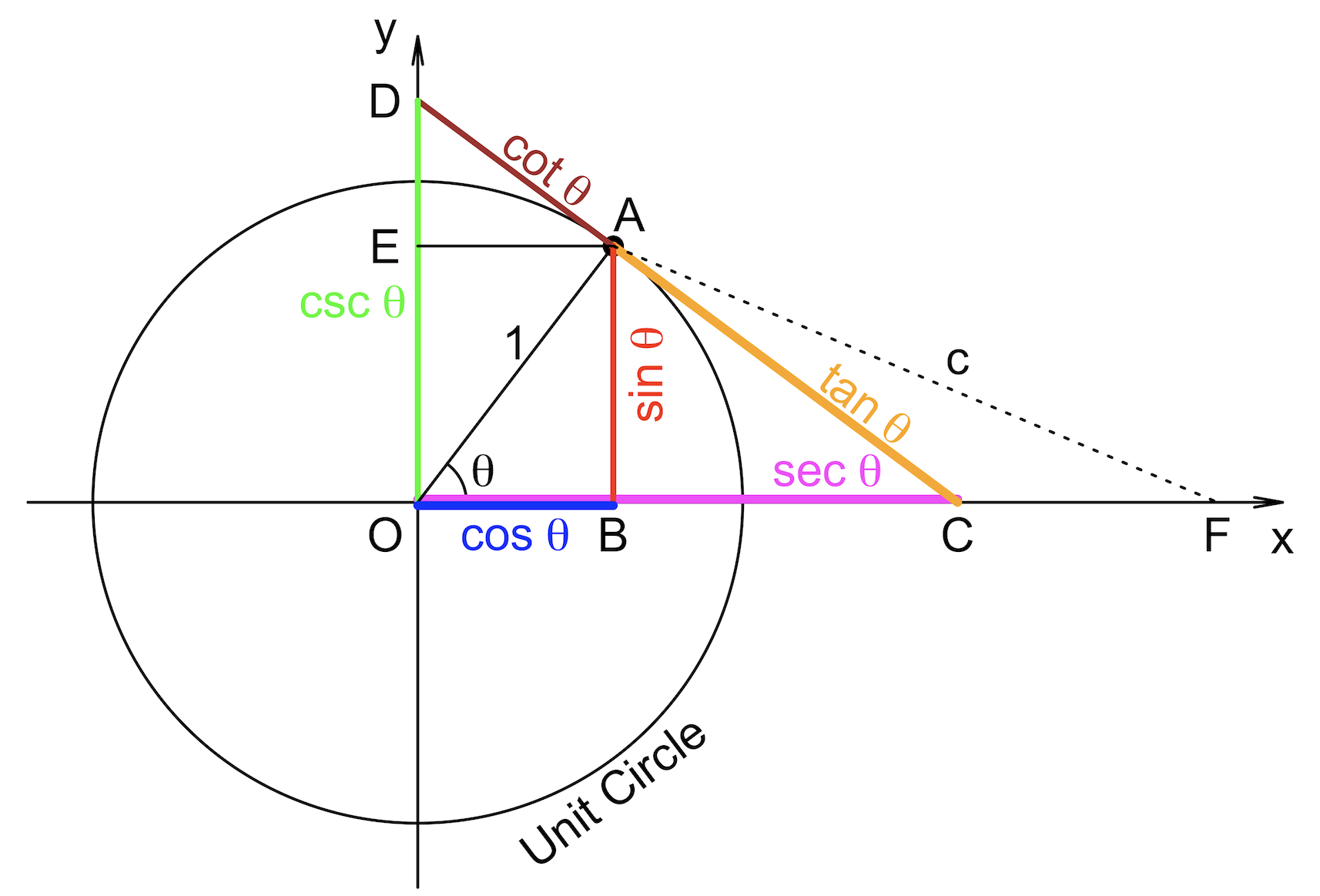
Here, we provide materials based on our Story-Picture-Observe-Review-Tell (SPORT) pedagogy to teach or learn mathematics effectively and efficiently, with depth and insight. Our approach is to use a single figure to explain all the definitions, fundamental identities, and their proofs of trig functions. This approach can be summarized as One-Figure-For-Every-Relation (OFFER).
SPORT is a pedagogy for mathematics education and is derived from learning-by-doing. SPORT assumes that students should first learn materials useful to them. Almost all the useful mathematics definitions, theorems, formulas, and algorithms have fantastic stories behind them. Each story must have a pictorial illustration. Hand-drawing such a picture can enhance the student’s understanding of the mathematical theory. Teachers can inspire students to observe the picture(s) and lead them to reinvent the theory in classrooms. Students can independently redraw the figures, observe them, and reach their own conclusions and extensions beyond textbooks. This S-P-O process can be reviewed or repeated many times to enhance learning. Ancient Chinese educator Confucius said that “To learn the new, review the old.” Finally, students can master the materials and tell stories to others. This completes the entire SPORT learning cycle.
The SPORT mathematics education, in nature, requires instructors to focus on the most fundamental and most useful materials. One-Figure-For-Every-Relation (OFFER) is a concrete approach to using the SPORT pedagogy. As an example of OFFER, this article uses only one figure to explain and derive all the fundamental trigonometric formulas. In another article, we will use a single formula to explain and derive all the fundamental theorems of calculus. In this way, we can liberate students from massive textbooks of more than 1,000 pages and lead them to see the insight, power, depth, and beauty of mathematics.
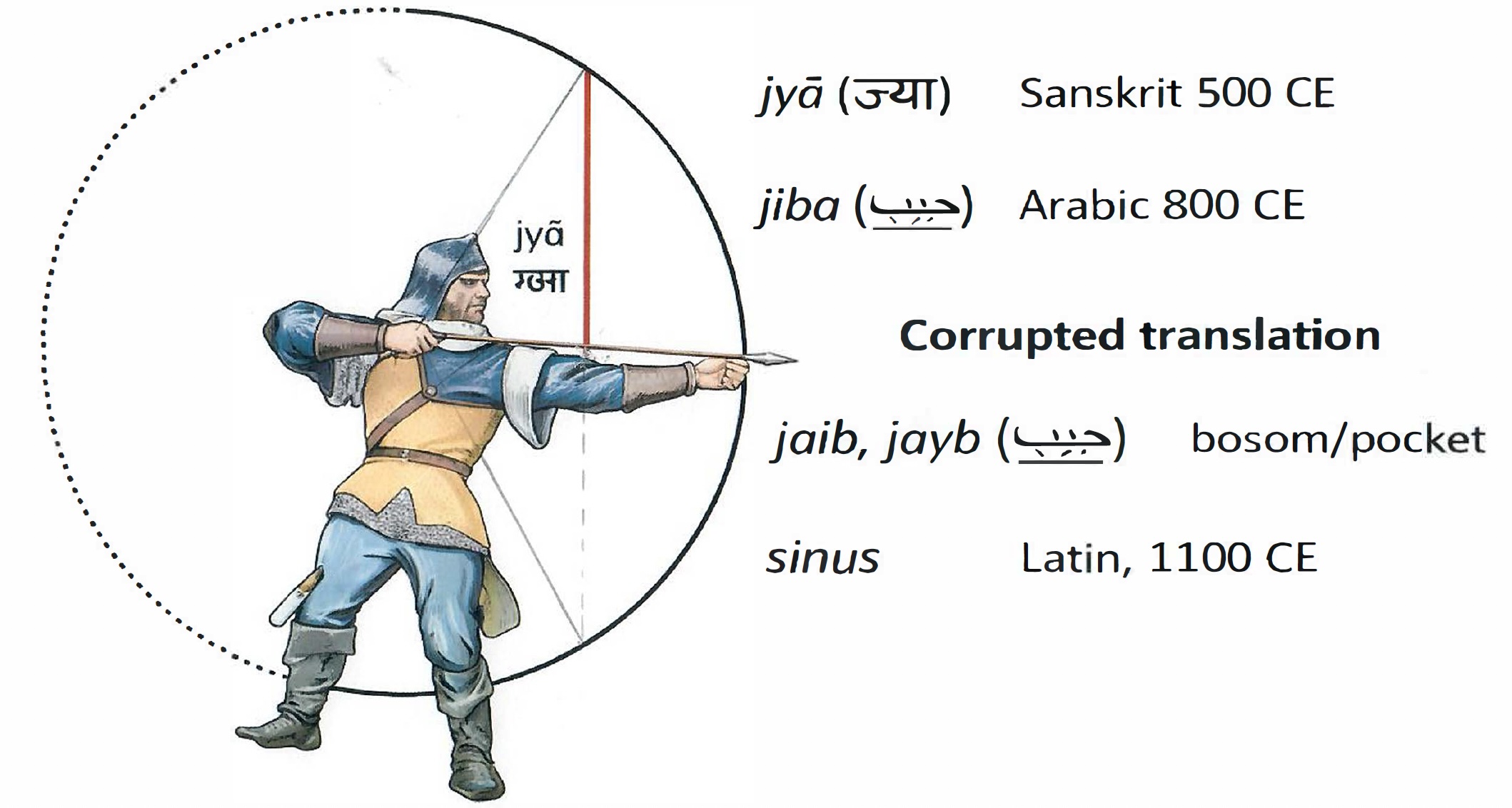
Trigonometric functions, particularly the sine and cosine, were invented by the Indian mathematician and astronomer Aryabhata (476 - 550 CE). He abstracted the bow-arrow shape in archery into a triangular geometry as shown in the above figure.
Aryabhata regarded the rigid bow of an archery set as a part of a circle, and the elastic string as a chord. When it is pulled, the upper half-string and the arrow form an angle θ, as shown in the figure. The original position of the upper half-string is called the half-chord, ardha-jya, the Latin spelling of the Sanskrit term ardhajyA. Here, ardha means half, and jya chord. In Sanskrit mathematics writing, jya was used, and ardha was omitted. Aryabhata included this in his 499 CE book named “Aryabhatiya” written in Sanskrit. In the book, he included a table of jya values, the first known sine table. The meaning of jya, i.e., the half-chord, got distorted, but it is still used today in our books, class- rooms, and computer programs. Sanskrit jya was phonetically transcribed to Arabic as jiba around 800 CE. In written Arabic, short vowels are often omitted. In this case, jiba became j-b. Later Arabic readers and the 1100 CE European translators mistakenly regarded the vowelless jb as the commonly used word jaib, since jiba was a rare Arabic word as a technical term. This misreading led to a very different meaning, jaib meaning “bosom” of a female body, “bay” in the bay window, “pocket,” “bend,”, “gulf,” or “fold,” whose Latin correspondence is sinus, meaning a curved surface. Later, sinus was anglicized into sine, i.e., the function sin(x).
REFERENCES: